This is a follow – up to my post in late February, “A battery project”. I was curious about the actual amp-hour capacity of the battery, compared to the nominal capacity printed on the label, and generally interested to learn a bit more about a key element of portable radio operating.
The setup:
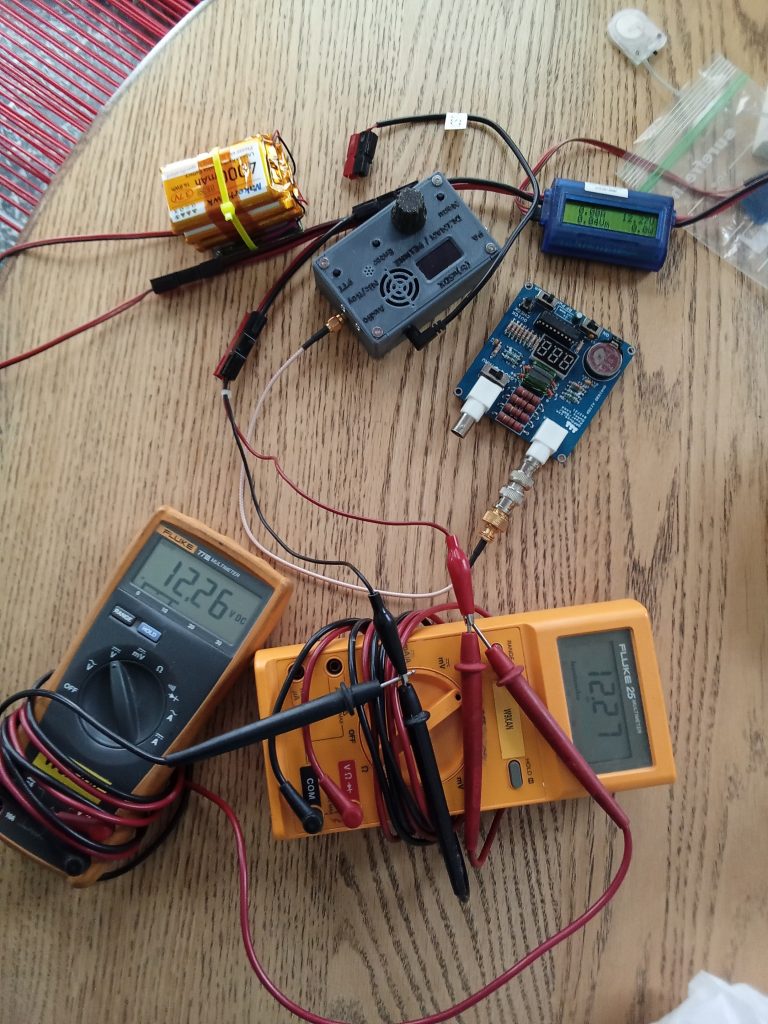
The equipment:
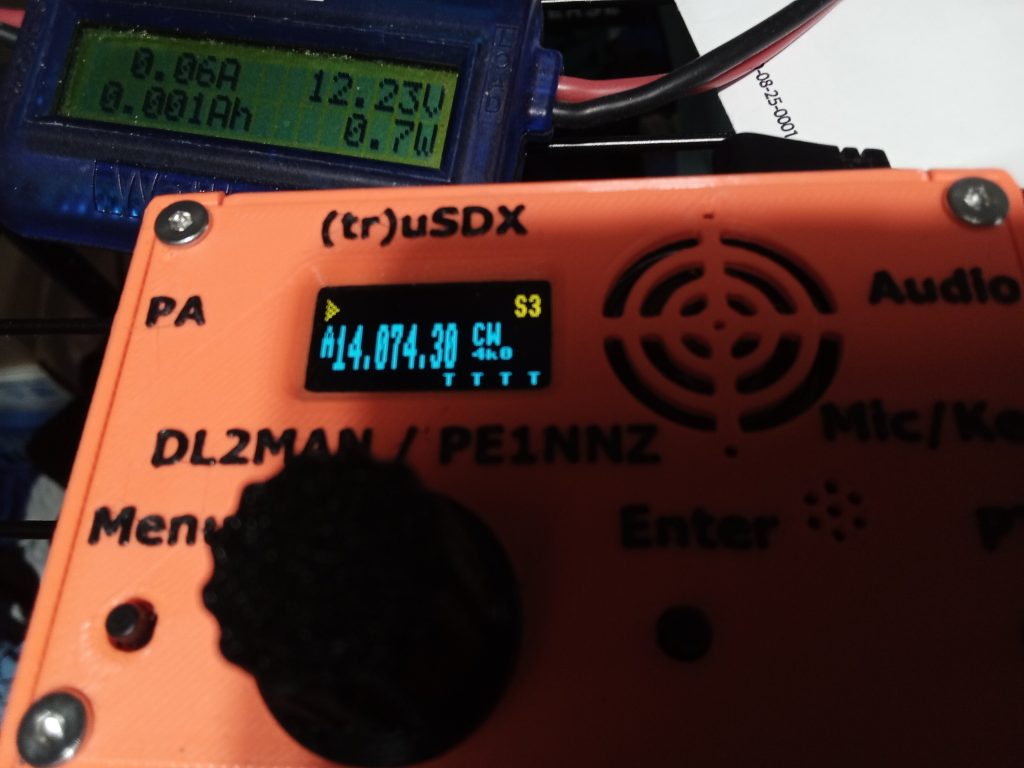
- The test load is a (tr)uSDX transceiver drawing about 60 mA on receive.
- RC Electronics Watt’s Up (rev. 2.1) DC multimeter, used to measure voltage, ampere-hours, and watt-hours.
- QRPguys SWR / power meter, mostly there as a dummy load to protect the PA transistors if I happen to transmit.
- The Fluke DMMs are used only to check calibration.
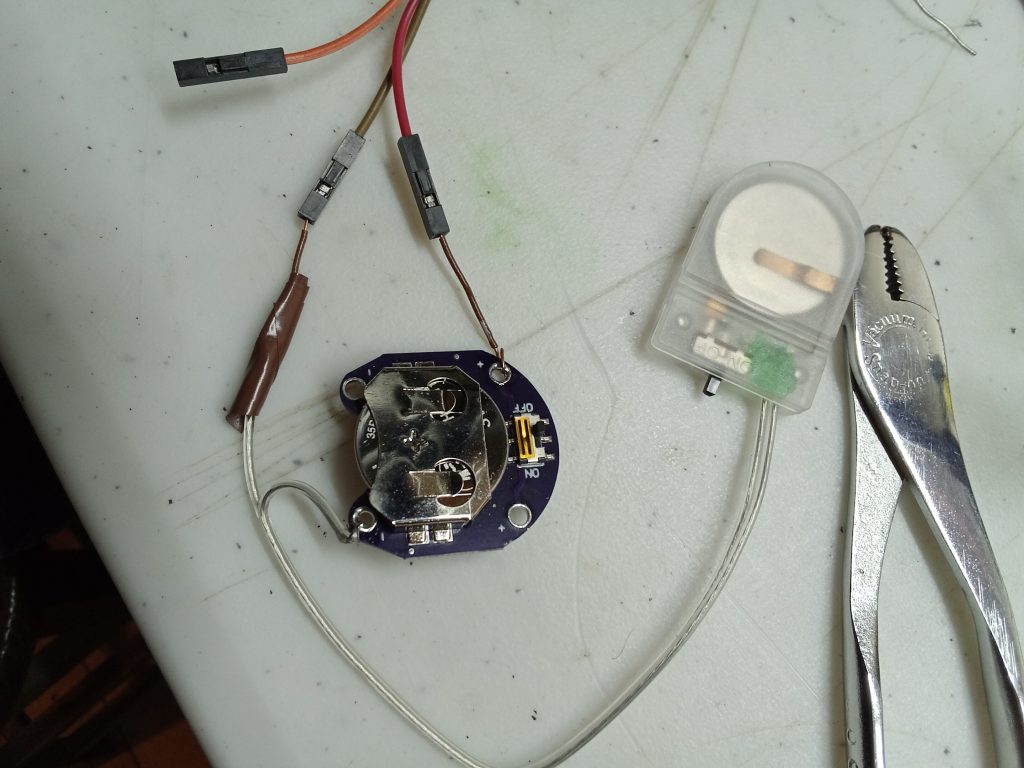
I have been through 3 full charge – discharge cycles now, and still don’t have a data set without gaps, interruptions, and loss of data. There seems to be an intermittent fault in the battery pack itself which triggers a shutdown which is only cleared by disconnecting and reconnecting the load; I think this points to the BMS board. Short circuit / overcurrent? Not sure; I am going to take the pack apart and examine it carefully, for a start. There may be other intermittent problems, too; it seemed like the external power failed on one occasion. In any case I have paused this project for the moment, subject to verifying the equipment and setup.
A few extracts from my patchy and incomplete data:
- Capacity of the pack seems to be about 2.8 Ah
- Voltage under load starts at 12.23, the BMS shuts it down at 9.41
- About 50 hours run time for the (tr)uSDX receiver, volume set at 11
It seems like the run-time has increased over the course of the 3 trials, implying an increase in amp-hour capacity, but it’s hard to put a number on it.
And incidental data from the (tr)uSDX: Transmitting on 20 meters into 50 ohm dummy load @ 11.12 volts, 0.73 amps (8.1 watts) input (measured by the Watt’s Up) gives 5.29 watts out on as measured by the (tr)uSDX itself; or 5.19 watts out measured by the QRPguys meter.
Watch for a Part 2 post when I (hopefully) have better data to present.
Thanks for visiting driftlessqrp!